

The Factions of the Cellium Age
Austrian Empire | British Empire | French Republic | Kingdom of Prussia|
Russian Empire | The Pirate Syndicate

Scientific and industrial inquiry advances alongside these conditions. Engineers, chemists, and inventors pursue new materials, new energy systems, and new methods of production. Research occurs within universities, private firms, military bureaus, and informal networks of correspondence. Cellium appears within this environment as a subject of investigation tied to experimental chemistry and materials science. Knowledge of its properties remains concentrated among specialists, shaping design discussions, funding decisions, and technical debate. Its presence integrates gradually into the broader stream of technological developments that begin to define the age.
During the Franco-Prussian War, these characteristics converged at the Battle of Sedan in 1870. As French forces became compressed near the town, visibility across the surrounding terrain degraded under smoke, elevation changes, and overlapping lines of fire. An engineering detachment deployed an experimental tethered platform assembled from reinforced framing and sealed water bags infused with a refined Cellium compound. The bags provided controlled lift sufficient to raise the structure above the battlefield while remaining anchored by ground lines. The platform carried a small squad of riflemen and a light cannon, positioned to fire downward across exposed approaches and relay observations by signal. From this elevated position, the airborne unit kept pressure on advancing formations and transmitted continuous reports on troop movement beyond the reach of ground observers. After the engagement, official records noted the tactical value of sustained elevation achieved through experimental lifting materials. Within military and engineering circles, the incident became a reference point in later discussions of lift-assisted platforms and the practical application of Cellium outside laboratory conditions.
During the Serbo-Bulgarian War of 1885, fighting along the Slivnitsa defensive line drew foreign involvement beyond advisors and supply. Russian command committed openly in support of Bulgarian forces, seeking to secure influence in the region and stabilize the front through direct intervention. Early in the engagement, a Russian airship, Svyatogor, appeared above the battlefield, its arrival intended to reinforce coordination and pressure Serbian positions through elevated fire and observation. The presence of the vessel dominated the field, visible to ground forces across the valley as artillery and infantry continued to exchange fire below.
Europe exists as a dense web of competing powers, layered authority, and accumulated history. Nations pursue influence through diplomacy, trade, military presence, and inherited claims, all shaped by earlier wars and negotiated settlements. Borders mark jurisdiction and obligation, defining where taxes are collected, armies are raised, and laws are enforced. Political authority operates through monarchies, parliaments, courts, churches, and professional administrations, each embedded in daily life as much through routine as through oppressive laws and enforced expectations of compliance. Power expresses itself in nearly every aspect of life.
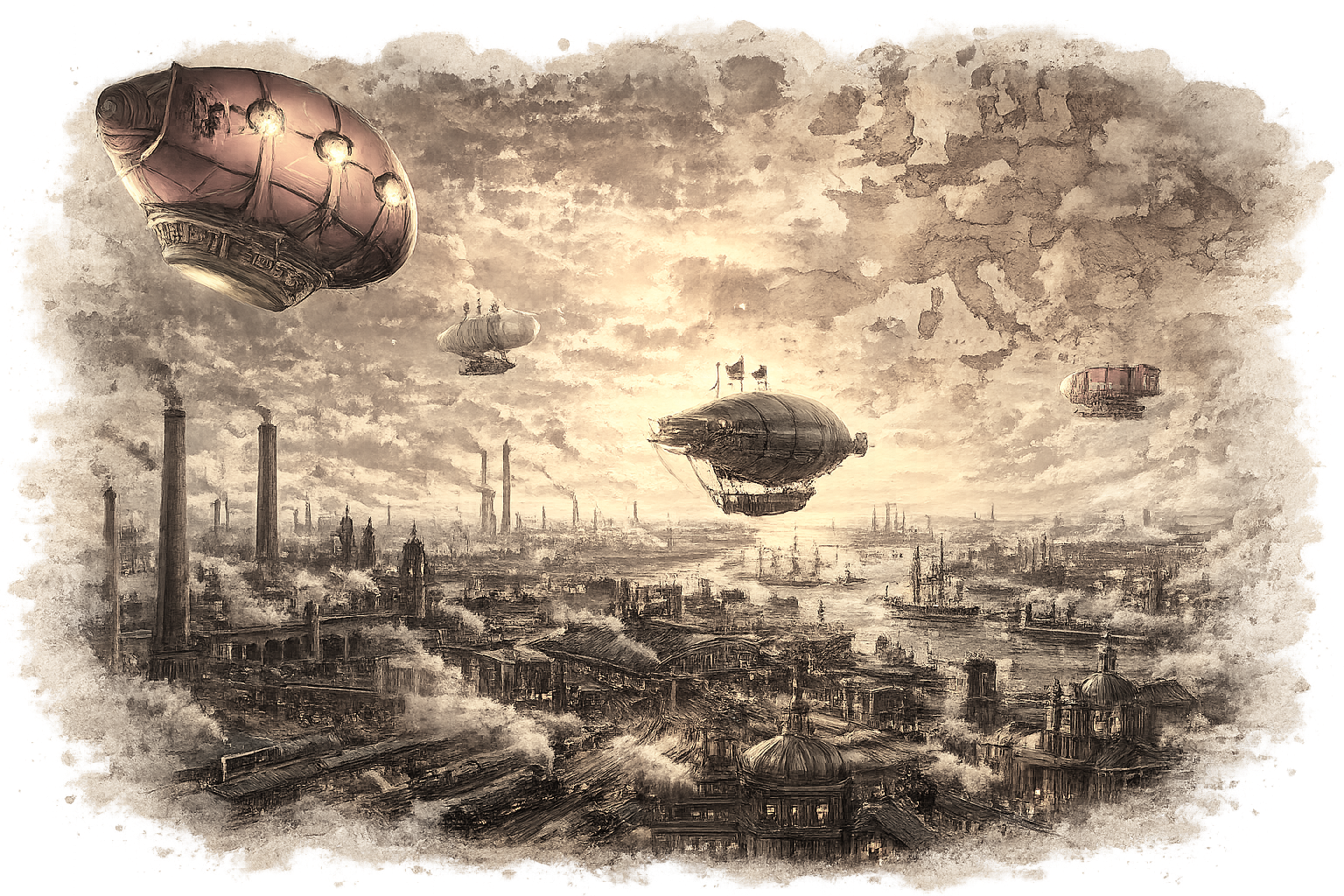
Less than an hour later, an Austrian airship, Kronvogel, entered the airspace from the west. Its arrival surprised Russian command, introducing a competing foreign presence over Slivnitsa. Austrian crews maneuvered to establish position, tracking both ground movement and the Russian vessel overhead. Shortly afterward, a Prussian airship, Eisenkrone, rose into view from the north, completing an encounter none of the three powers had planned for or anticipated. The sky above Slivnitsa now held three armed flying warships, each representing a rival interest converging over the same ground battle.
Tension escalated rapidly as crews signaled, repositioned, and sought advantage in altitude and orientation. Prussian gunners aboard Eisenkrone fired the first salvo, striking the lightly armored starboard side of Svyatogor. The impact ruptured external lift cells and tore through exposed structural bracing. Return fire followed within moments as Kronvogel and Svyatogor engaged in overlapping arcs. Smoke, flame, and falling debris spread across the sky above Slivnitsa as the airships maneuvered under fire. On the ground, combat stalled as infantry and artillery units paused under the shadow of the engagement overhead. Crews and soldiers watched as the behemoths traded fire, lost altitude, and struggled to maintain control.
Each vessel sustained significant damage. Svyatogor descended under reduced lift and withdrew eastward. Kronvogel broke contact after structural damage compromised stability. Eisenkrone disengaged with visible hull breaches and failing control surfaces. None were destroyed, yet none returned intact. Later military records across Europe identified the engagement over Slivnitsa as the first recorded battle between airships, and the moment when control of the sky became a matter of force.
Now, in the closing decade of the nineteenth century, airships occupy the skies above Europe and beyond. Their presence influences borders, commerce, and conflict as a visible expression of national ambition. Governments plan around aerial movement as part of routine statecraft, factoring altitude, range, and visibility into diplomacy and defense. Industries align production with the demands of lift capacity, containment, propulsion, repair yards, and trained crews capable of sustained service. Commercial traffic passes above terrain once shaped only by roads, rivers, and rail, while patrol routes and signal paths trace authority across the sky. For populations below, airships form part of the lived environment, casting shadows that signal power, reach, and expectation.
This is the world in which your battles begin. Captains command vessels that exist inside layered political pressures, economic demands, and rival ambitions that stretch far beyond any single engagement. Missions arise from contracts, crises, intelligence failures, and calculated risk, each shaped by the interests of nations that rarely act without consequence. Success brings recognition, resources, and advancement, binding crews more tightly to the systems that employ them. Failure leaves scars that persist through damaged hulls, lost influence, and remembered decisions. Game Play unfolds within a world that reacts, adapts, and remembers, where control of the sky carries weight equal to land and sea, and where every choice contributes to the direction of history.
Across Europe, these forces do not resolve into a single path or shared response. Each nation absorbs them through its own institutions, traditions, and ambitions, shaping how authority is exercised, how technology is deployed, and how conflict is justified. What follows are not exhaustive histories, but observations of how different powers operate within the same strained world, each adapting to pressure in ways that reflect its character and priorities.